Zone 2 cardio is boring! And that's exactly why it works.
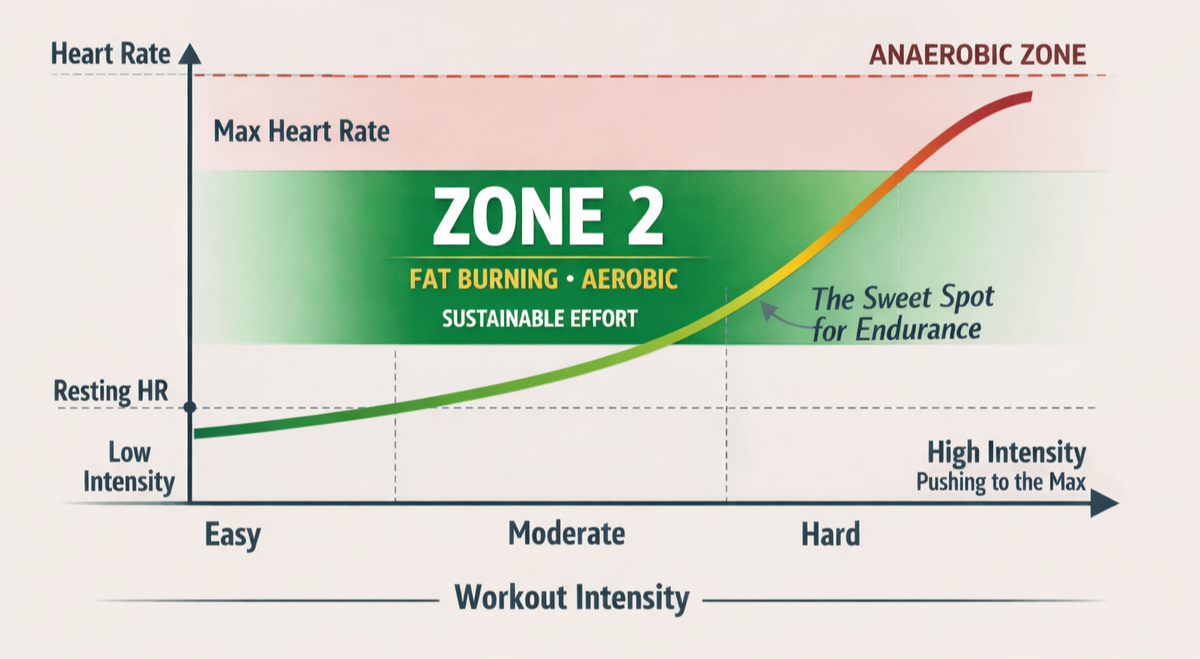
I find Zone 2 cardio super boring. It's one of those concepts that science says is super beneficial, yet I cannot stick to it. It is not challenging enough. My brain keeps nudging me to push harder, as if it's telling me "Hey! You can do better than this. Try going a bit faster." And I am not the only one with this issue. Plenty of people I talk to have the same issue. So I decided to dive a little deeper and find out:
- What is Zone 2 cardio?
- Why is it good for us?
- How do I make sure I do it right?
What is Zone 2 cardio?
Zone 2 is cardio exercise at a moderate heart-rate intensity, generally in the 60-70% range of the maximum heart rate. At this range our body primarily uses fat for fuel along with oxygen for energy. Our heart rate is slightly elevated, but not enough to push our body into anaerobic metabolism. Another way to check is that you can talk in sentences, not just single words, during the workout.
Slight detour towards nerdy physiology of Zone 2:
- Mitochondria (powerhouse of the cell) are maximally stimulated to burn fat and produce ATP efficiently. This increases long-term capability of the body to handle the cardio itself. Link
- Lactate doesn't accumulate faster than the body can clear it, which is the sweet spot for endurance. Link
- You predominantly recruit Type 1 (slow-twitch) muscle fibres, which are designed for endurance and sustained work. Link
Why is it good for us?
For long-term health and endurance building, Zone 2 is foundational:
- Your body gets better at using oxygen efficiently, meaning lower heart rates for the same effort and better performance across activities.
- Bigger and better mitochondria (powerhouses), which means better energy production, which correlates with metabolic health and longevity.
- Fat oxidation climbs, which reflects improved metabolic flexibility (shifting between burning fat and carbs).
Zone 2, thus, increases the capacity of your aerobic system. It might sound counterintuitive, but the slow pace of Zone 2 will help you go faster for longer in future. The higher intensity work then sits on top of that capacity. Without this base, chances are that your intensity would plateau faster. That is why pro level athletes stick mostly to Zone 2 cardio and test out max performance occasionally to validate the gains from Zone 2.
Despite these advantages, it is important to note that there is some pushback to Zone 2. Some studies have shown that it's good only in large doses, namely at least 45 min sessions. So if you're severely time-constrained, higher-intensity workouts may be a more practical choice.
So how do I make sure that I do it right?
At this stage in my fitness journey I try to stick to Zone 2 cardio as my vessel towards building a foundation to my long-term performance and health. I stick to two sessions of Zone 2 that last longer than 45 mins. As I alluded to earlier, it does get challenging for me to not increase my pace. My simple way of mitigating this is that I find my Zone 2 pace on a treadmill by making sure I am within my Zone 2 heart rate. During this cardio session I listen to a podcast that is engaging. The goal is to get so engrossed into the podcast, that the cardio becomes a secondary concern and I am on autopilot. I frequently test if I am actually in Zone 2 using the speech test. I let myself exclaim or talk to myself about the podcast.
Here is a short mental checklist to ensure that you are in your Zone 2:
- Can I talk in full sentences?
- Would I be embarrassed to post this pace online? On Strava maybe?
- Could I keep this up for an hour?
Zone 2 isn't exciting. But neither is brushing your teeth. Skipping it has predictable consequences.
If you’re curious where your Zone 2 heart rate actually lies…
Check out a battle tested ChatGPT prompt that I use to determine my Zone 2 heart rate in the following link: https://www.thelongrep.com/find-your-real-zone-2/
Zone 2 only works if it's part of a bigger, sensible plan. Do you want a fitness plan that is built with long-term fitness in mind? Find out more in the following link: Link